“Dry” fire hydrant design

So talking with a guy about the California fires and of course he brings up the risk of wildfires here in rural PA.
Well it turns out there are guys up here who have a “dry” fire hydrant at their house. I hadn’t heard of this but basically it uses a pond or even a pool to act as a fire hydrant in an emergency.
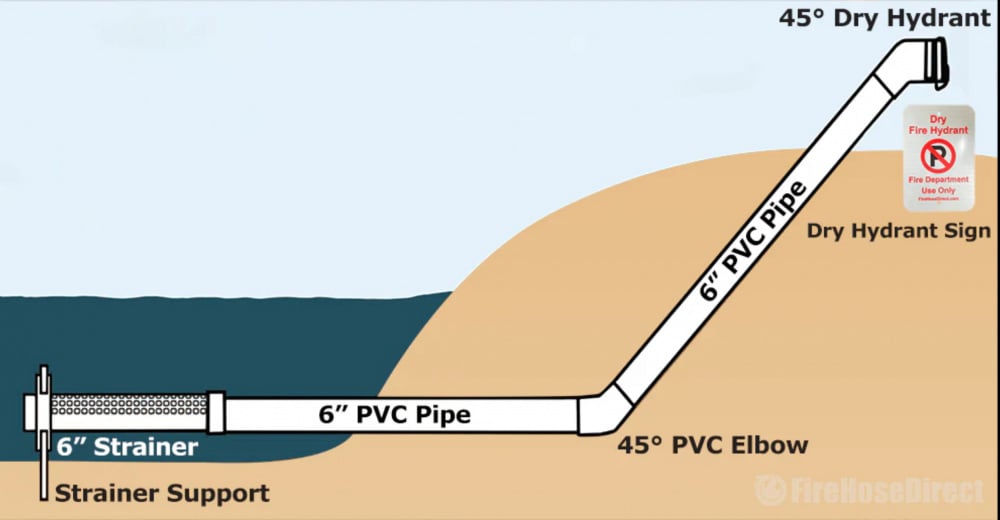
Heres how it works:
In rural areas where municipal water systems are not available, dry hydrants are used to supply water for firefighting. A dry hydrant is analogous to a standpipe. Dry hydrants are usually an unpressurized, permanently installed pipe with one end below the water level of a lake or pond. This end usually has a strainer to prevent debris from entering the pipe. The dry hydrant, located above ground, has a hard sleeve connector. When needed, a pumper fire engine will pull water from the nearby lake or pond. This is done by vacuuming the air out of the dry hydrant and utilizing the fire engine pump with a primer. Because lower air pressure now exists at the pump intake, atmospheric pressure on the water and the weight of the water forces water into the part of the dry hydrant above land. This water can then be pumped by the engine's centrifugal pump.
-

Yep, as pump driver, operators for a vol fire dept. (30 something years ago) both my wife and I have drafted off dry hydrants many times. Have drafted directly out of streams, ponds,irrigation canals without dry hydrants also. For drafting you use the hard rubber sections of hose you see on the side of fire trucks and hope you don't collapse them. You're pulling water under negative pressure.
3 -

Great idea.
3 -

That has me thinking about some ideas for around the farm…. We get some pretty dry summers around here !
6 -
Many commercial busines here outside of the city, (no city water) have fire ponds on the property. The pond supplies water to the buildings fire suppression system and also has a dry hydrant. The building also has a fire hose connection on the outside wall of the building. Should power go out, shutting down the suppression system. The pumper drafts off the dry hydrant, and runs a 6 inch line off the pressure side of the pumper to connect to the connection on outside of building. This line is tied into the suppression system. WA la, suppression system still functional, and crews can still pull hand lines if need be, but water supply goes fast when pushing a 6inch line.
3 -

Actually quite a few of these in farm country. Added to easily accessible USDA/NRCS designed and cost shared flood control or water impoundment structures. I can think of at least two within 5 miles of where I'm sitting now.
6 -

We still maintain a few of them in our district .
6 -

Here in WNC Dry hydrants are just about the only source.
Note, fire pumps do not suck.
3 -

So more or less a swimming pool with a built in straw.
3 -
Yes, and any water source will do as long as it is close enough to the pump truck and deep enough to cover intake strainer. River or pond, just as long as it contains enough water to fill the tanks.
There is a device called a turbo draft that allows water pick up at much longer distances.
3 -
"So more or less a swimming pool with a built in straw."
Often at least an acre of surface area up to 20' deep—that's quite a 'pool'.
3 -

This is the problem they have in California, no one ever explained to them that water doesn’t run up hill, and that you cannot draw/vacuum water up higher than 34 feet. You can pump it up hundreds of feet from the bottom up, but you can only draw it up approximately 34 feet; this is because the weight of the water column at this height counteracts the atmospheric pressure preventing further lifting.
15 -
Atmospheric pressure comment is very correct.
We have one source at 2500 feet elevation and one at 4200 feet.
The 4200 one is much harder to draft from.
3 -

We have those type of fire hydrants in various ponds in our area. Being in a rural area we have no hydrants. If there is a fire the tankers pull up to the standpipe that is near the road and fill up. They dump the water in a big folding tank at the fire. The fire hoses draw water from the folding tank to put on the fire.
6 -
Yes sir ^^^^
3 -
Fire pumps neither suck or draw water.
See waltermoe's post.
0 -

It don't take long for two or three 2" hoses to empty a 1000 gallon tanker.
0 -
Yep^^^
Or run the deck gun
3 -
I was looking at Ynez Reservoir. The one coincidently was dry and "under repairs" in L.A. County. It's dry in google maps I wouldn't know what it was if it wasn't tagged as a reservoir.
0 -
Departments must test their pumpers yearly. Pumper rated at 1000 GPM. 2000 gallon drop tank
full of water don't last long. Takes about three 2 1/2 inch hoses to flow that amount.
0 -

Am I the only gun guy who had the thought, "How do you dry fire a hydrant?"
6 -

Rocky Raab: 33163696452379/comments/33163698116379
Am I the only gun guy who had the thought, "How do you dry fire a hydrant?"
you open the valve and dust comes out……….
0 -
Sounds like California had several hydrants to "dry" fire!
6
Please sign in to leave a comment.
Comments
22 comments