Ok Gun Math Gurus - this is for you

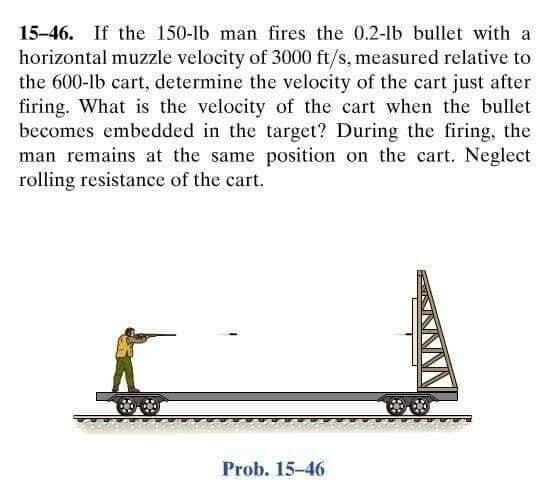
-

 18
18 -

I don't think enough information is given. What is the weight of the rifle?
Some info that can be extrapolated if I assume a 12# rifle with 100 grs of powder:
1400gr bullet @ 3000 ft/sec will generate 576 ft/# of recoil energy and a recoil velocity of 55.6 ft/sec. One of the smarter folk on here can continue from there. Bob
Edit to add - how will a 150# shooter remain on the cart with 576# of recoil?
9 -

A 1400 grain bullet going 3000fps?
The answer is 0, the cart is going zero due to the 150lb guy being blown off the end of it in a somersault will have little effect on the cart.
15 -

I tried and tried but could not come up with a answer. I know for every action there is a re-action. Does that count? ---------------------------Ray
PS: I will try to get my son the ME to help me.😀
0 -
Brookwood: 30338384506395/comments/30338390815259
https://us.v-cdn.net/6031683/uploads/M58OSE8TX4K0/crazy-faced-cowboy.jpg
Say what?????????????? ------------Ray
0 -

I think the cart does not move because the impact energy of the bullet against the cart counteracts the recoil energy.
0 -

Conservation of momentum yields the following theoretical speeds:
Assume the rifle weighs 6 Lbs.
The total weight of the system is thus 600+150+6+.2 = 756.2 Lbs.
Initial condition is that the system is at rest.
At the moment of firing, .2 Lbs. is moving at 3000 ft/sec. in the positive direction. As the remainder of the system is assumed to be in a zero friction condition, it will move in the negative direction at a speed inversely proportional to its mass wrt to the bullet.
So: 756 x V1 = .2 x V2 (3000 fps)
V1 = -.79 fps.
After impact, and the bullet embedding into the cart, the problem is reversed, and the system will come back to a stop.
Obviously this neglects the mass of the propellant which will also be accelerated in the direction of V1 and will not be absorbed by the cart.
From a practical standpoint, the man is not a rigid transferrer of the recoil to the cart, and the reality of the system is that the absorption of the recoil over time by the man will take longer than the flight time of the bullet, so the recoil force will not be fully transferred to the cart prior to the impact of the bullet.
The real-world situation will be the firing of the rifle, a slight movement of the cart in the positive direction as the bullet embeds, with the cart coming to a halt once the recoil force has been fully transmitted from the man's shoulder through his body to the cart.
0 -
BobJudy: 30338384506395/comments/30338379395995
I don't think enough information is given. What is the weight of the rifle?
Some info that can be extrapolated if I assume a 12# rifle with 100 grs of powder:
1400gr bullet @ 3000 ft/sec will generate 576 ft/# of recoil energy and a recoil velocity of 55.6 ft/sec. One of the smarter folk on here can continue from there. Bob
Edit to add - how will a 150# shooter remain on the cart with 576# of recoil?
Well, I assume the gun itself will weigh more than 80lbs. That should tame the recoil a bit. It also makes the weight of the rifle not insignificant to the problem, unless the gun weighs 100 lbs and the dude weighs 50 or something. For reference, a 20mm Solothurn weighs about 118 lbs.
0 -
BobJudy: 30338384506395/comments/30338379395995
I don't think enough information is given. What is the weight of the rifle?
Some info that can be extrapolated if I assume a 12# rifle with 100 grs of powder:
1400gr bullet @ 3000 ft/sec will generate 576 ft/# of recoil energy and a recoil velocity of 55.6 ft/sec. One of the smarter folk on here can continue from there. Bob
Edit to add - how will a 150# shooter remain on the cart with 576# of recoil?
Do not confuse 576 ft-lbs of energy with 576 pounds of force.
6 -
Don McManus: 30338384506395/comments/30338409638171
Conservation of momentum yields the following theoretical speeds:
Assume the rifle weighs 6 Lbs.
The total weight of the system is thus 600+150+6+.2 = 756.2 Lbs.
Initial condition is that the system is at rest.
At the moment of firing, .2 Lbs. is moving at 3000 ft/sec. in the positive direction. As the remainder of the system is assumed to be in a zero friction condition, it will move in the negative direction at a speed inversely proportional to its mass wrt to the bullet.
So: 756 x V1 = .2 x V2 (3000 fps)
V1 = -.79 fps.
After impact, and the bullet embedding into the cart, the problem is reversed, and the system will come back to a stop.
Obviously this neglects the mass of the propellant which will also be accelerated in the direction of V1 and will not be absorbed by the cart.
From a practical standpoint, the man is not a rigid transferrer of the recoil to the cart, and the reality of the system is that the absorption of the recoil over time by the man will take longer than the flight time of the bullet, so the recoil force will not be fully transferred to the cart prior to the impact of the bullet.
The real-world situation will be the firing of the rifle, a slight movement of the cart in the positive direction as the bullet embeds, with the cart coming to a halt once the recoil force has been fully transmitted from the man's shoulder through his body to the cart.
A 6 lb rifle? That shoots a 15 - 20 mm projectile @ 3000 ft/sec??
0 -
Don McManus: 30338384506395/comments/30338409638171
Conservation of momentum yields the following theoretical speeds:
Assume the rifle weighs 6 Lbs.
The total weight of the system is thus 600+150+6+.2 = 756.2 Lbs.
Initial condition is that the system is at rest.
At the moment of firing, .2 Lbs. is moving at 3000 ft/sec. in the positive direction. As the remainder of the system is assumed to be in a zero friction condition, it will move in the negative direction at a speed inversely proportional to its mass wrt to the bullet.
So: 756 x V1 = .2 x V2 (3000 fps)
V1 = -.79 fps.
After impact, and the bullet embedding into the cart, the problem is reversed, and the system will come back to a stop.
Obviously this neglects the mass of the propellant which will also be accelerated in the direction of V1 and will not be absorbed by the cart.
From a practical standpoint, the man is not a rigid transferrer of the recoil to the cart, and the reality of the system is that the absorption of the recoil over time by the man will take longer than the flight time of the bullet, so the recoil force will not be fully transferred to the cart prior to the impact of the bullet.
The real-world situation will be the firing of the rifle, a slight movement of the cart in the positive direction as the bullet embeds, with the cart coming to a halt once the recoil force has been fully transmitted from the man's shoulder through his body to the cart.
I was right, one of the smarter folk did chime in with an answer. What would your thoughts be if a muzzlebreak was added to the firearm redirecting some of the propellant thrust to the side thus slowing the recoil impulse to the shooter?
Mr. Perfect: 30338384506395/comments/30338417653403
https://forums.gunbroker.com/discussion/comment/11386244#Comment_11386244
Well, I assume the gun itself will weigh more than 80lbs. That should tame the recoil a bit. It also makes the weight of the rifle not insignificant to the problem, unless the gun weighs 100 lbs and the dude weighs 50 or something. For reference, a 20mm Solothurn weighs about 118 lbs.
That's why I said not enough information and used the weight of a lightweight Africa big bore rifle in my calculations. The illustration doesn't indicate an 80#+ rifle because that would look much larger in proportion to the figure of the shooter.
Bob
3 -
Mr. Perfect: 30338384506395/comments/30338443115675
https://forums.gunbroker.com/discussion/comment/11386255#Comment_11386255
A 6 lb rifle? That shoots a 15 - 20 mm projectile??
You said math gurus, not gun gurus. 😳
If you want a 100 Lb. rifle, it doesn't change the math very much. V1 becomes -.7 fps with a 100 lb. rifle.
3 -
BobJudy: 30338384506395/comments/30338432910491
https://forums.gunbroker.com/discussion/comment/11386255#Comment_11386255
I was right, one of the smarter folk did chime in with an answer. What would your thoughts be if a muzzlebreak was added to the firearm redirecting some of the propellant thrust to the side thus slowing the recoil impulse to the shooter?
https://forums.gunbroker.com/discussion/comment/11386257#Comment_11386257
That's why I said not enough information and used the weight of a lightweight Africa big bore rifle in my calculations. The illustration doesn't indicate an 80#+ rifle because that would look much larger in proportion to the figure of the shooter.
Bob
Well, the author of the problem thinks the thing can be shoulder fired too. A 50 BMG round is what about 800 grains on the heavy end? Those bullets travel in about the same velocity range, and that is about the upper limit of what can be shoulder fired.
0 -
Don McManus: 30338384506395/comments/30338428802843
https://forums.gunbroker.com/discussion/comment/11386263#Comment_11386263
You said math gurus, not gun gurus. 😳
If you want a 100 Lb. rifle, it doesn't change the math very much. V1 becomes -.7 fps with a 100 lb. rifle.
As a point of fact, I said "gun math gurus". :)
3 -

Since this scenario is using a rail cart and rail carts are forms of transportation and Pete Buttigieg is the Secretary of Transportation my answer is: By the time the bullet becomes embedded in the target the cart will have derailed and come to a complete rest somewhere in the middle of Ohio.
21 -

For every action there is an opposite and equal re- action according to Newton. It would be the same as having a sail on a boat and a fan attached to the boat blowing on the sail, you’re not going to move.
9 -
waltermoe: 30338384506395/comments/30338463234971
For every action there is an opposite and equal re- action according to Newton. It would be the same as having a sail on a boat and a fan attached to the boat blowing on the sail, you’re not going to move.
That is true for the entire course of events presented, but the problem is broken down into stages. The first "equal and opposite reaction" is the movement rearward of all the mass except the bullet (in reaction to the bullet being fired), and that is what is asked.
0 -

So the cart moves backward and the bullet stays still until the end of the cart runs into the bullet, thus stopping the cart. 😵
18 -
Anti Kue: 30338384506395/comments/30338451864091
So the cart moves backward and the bullet stays still until the end of the cart runs into the bullet, thus stopping the cart. 😵
Um.... no. If you look at Don's analysis, Vcart = .79 ft/sec and Vbullet = 3,000 ft/sec (which was given). Assuming rigid connections, you might not even see any movement of the cart at all before the bullet hits the target and stops all motion (as you would expect).
3 -

Mr. Perfect: 30338384506395/comments/30338469618715
https://forums.gunbroker.com/discussion/comment/11386293#Comment_11386293
Um.... no. If you look at Don's analysis, Vcart = .79 ft/sec and Vbullet = 3,000 ft/sec (which was given). Assuming rigid connections, you might not even see any movement of the cart at all before the bullet hits the target and stops all motion (as you would expect).
I was not expecting that. Don
0 -
dcon12: 30338384506395/comments/30338478462619
https://forums.gunbroker.com/discussion/comment/11386298#Comment_11386298
I was not expecting that. Don
Assuming the image is to scale, and that the person shooting is 6 feet tall, the cart is roughly 30 feet long. The bullet originates at a point about 6 feet from one end, so the distance traveled is 24 ft. At 3000 ft/sec it will cover the 24 ft in 0.008 seconds (assuming constant velocity). In that amount of time, the cart will have moved approximately 0.076 inches (about the thickness of 19 sheets of paper).
0 -
Anti Kue: 30338384506395/comments/30338451864091
So the cart moves backward and the bullet stays still until the end of the cart runs into the bullet, thus stopping the cart. 😵
Not to fret.... I've passed this intellectual problem to a Super Genius -

I'm sure he will get right on it. 😁 Bob
12 -
@Mr. Perfect. I understand the stages that you are looking at now, and a can appreciate the answer that you are looking for better. However one part of the question is missing. The distance from muzzle to the target, with out it you can’t figure the time of flight of the projectile from muzzle to target.
For instance if the muzzle was against the target there would be no flight time, and then there would be no movement. With distance figured in I would imagine you could figure the velocity of the cart before projectile impacts the target. Interesting question though and food for thought.
0 -
waltermoe: 30338384506395/comments/30338480664347
@Mr. Perfect. I understand the stages that you are looking at now, and a can appreciate the answer that you are looking for better. However one part of the question is missing. The distance from muzzle to the target, with out it you can’t figure the time of flight of the projectile from muzzle to target.
For instance if the muzzle was against the target there would be no flight time, and then there would be no movement. With distance figured in I would imagine you could figure the velocity of the cart before projectile impacts the target. Interesting question though and food for thought.
I provided that calculation for you above.
0 -

waltermoe: 30338384506395/comments/30338463234971
For every action there is an opposite and equal re- action according to Newton. It would be the same as having a sail on a boat and a fan attached to the boat blowing on the sail, you’re not going to move.
Not true, ever watch Myth Busters ..................................... 😉
0 -

You guys are looking at it the wrong way. The man shoots the rifle, the bullet ricochets off the metal frame and goes right back at the man killing him instantly. So the answer is zero.
Glad I could sort this out for you.
Joe
3 -

Don McManus: 30338384506395/comments/30338409638171
Conservation of momentum yields the following theoretical speeds:
Assume the rifle weighs 6 Lbs.
The total weight of the system is thus 600+150+6+.2 = 756.2 Lbs.
Initial condition is that the system is at rest.
At the moment of firing, .2 Lbs. is moving at 3000 ft/sec. in the positive direction. As the remainder of the system is assumed to be in a zero friction condition, it will move in the negative direction at a speed inversely proportional to its mass wrt to the bullet.
So: 756 x V1 = .2 x V2 (3000 fps)
V1 = -.79 fps.
After impact, and the bullet embedding into the cart, the problem is reversed, and the system will come back to a stop.
Obviously this neglects the mass of the propellant which will also be accelerated in the direction of V1 and will not be absorbed by the cart.
From a practical standpoint, the man is not a rigid transferrer of the recoil to the cart, and the reality of the system is that the absorption of the recoil over time by the man will take longer than the flight time of the bullet, so the recoil force will not be fully transferred to the cart prior to the impact of the bullet.
The real-world situation will be the firing of the rifle, a slight movement of the cart in the positive direction as the bullet embeds, with the cart coming to a halt once the recoil force has been fully transmitted from the man's shoulder through his body to the cart.
Darn it Don, You must have read my mind. That is EXACTLY what I was going to post. Thanks for saving me the typing time.
9 -

I suspect you meant .02 lb. (140 gr.), not .2 lb. which would be 3.2 oz. or 1400 gr.
3 -

The recoil force equals the impact force minus the energy spent moving air.(opposite directions) So the cart will move slightly with the recoil.
Assuming the shooter can maintain his position on the car after firing a 20mm cannon, silly.
If he was standing off the cart, it would move much faster(100x?) in the opposite direction with the impact.
Or if he misses the target(and doesn’t hit the cart) . It will accelerate (101x) WTH the recoil only
3 -

If he misses the target and with no rolling resistance (assuming a zero grade) the cart would probably travel to Omaha before air resistance would stop it. 😉
0

Please sign in to leave a comment.
Comments
39 comments