Little Kid Bitten by Copperhead

Snake scare: Copperhead bites Tennessee preschooler during camping trip
A 3-year-old boy from Chattanooga is recovering after a copperhead snake bit him during a camping trip in North Carolina.
CHATTANOOGA, Tenn. (WTVC) — A 3-year-old boy from Chattanooga is recovering after a copperhead snake bit him during a camping trip in North Carolina.
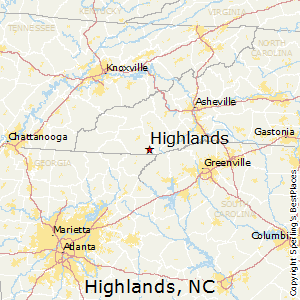
Jad Pollom was camping with his family in North Carolina over Memorial Day weekend at the Highlands, near the Georgia border.
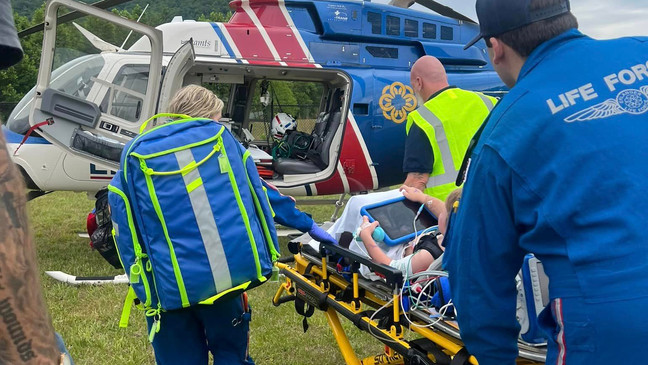
Copperhead bites Tennessee preschooler during camping trip (Photo: Stacey Pollom)
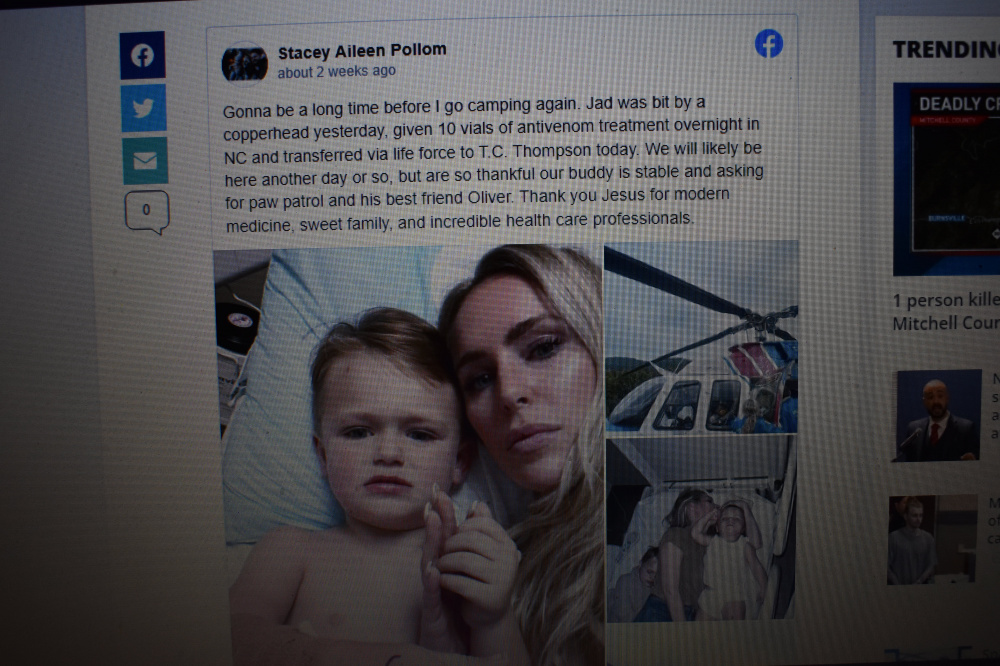
Jad's mother Stacey said he was outside a cabin playing on the porch when he was bit.
His father, Jesse. had the wherewithal to take a picture of the snake as it slithered away.
They rushed Jad to a local emergency room, where he got 10 vials of anti-venom treatment.
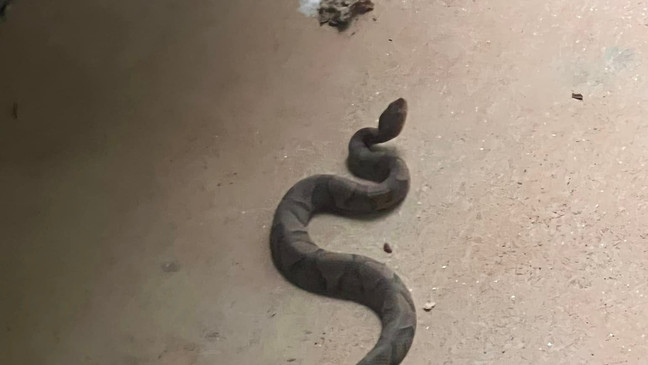
Jad's father Jesse managed to take a photo of the culprit before it slithered away, which was crucial help for medical professionals treating Jad in the E.R. Photo via Stacey Pollom.
But that apparently wasn't enough and the skin near his right ankle continued to swell.
A LIFEFORCE helicopter soon flew Jad to Children's Hospital at Erlanger for extra care. Jad's parents say it was their 'worst nightmare' to not be flying with their son.
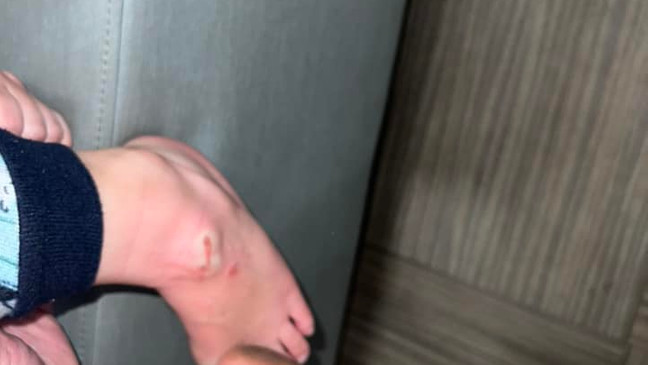
Copperhead bites Tennessee preschooler during camping trip (Photo: Stacey Pollom)
A day after he was admitted, Stacey Pollom posted an update on Facebook.
So thankful our buddy is stable and asking for paw patrol and his best friend Oliver,' Pollom wrote. 'Thank you Jesus for modern medicine, sweet family, and incredible health care professionals.
Jad stayed in the hospital for 3 days, and he's now home.

Copperhead bites Tennessee preschooler during camping trip (Photo: Stacey Pollom)
WTVC outdoors correspondent Richard Sims spoke about the dangers of copperheads.
He said while the majority of snakes in Tennessee don't have dangerous venom, copperheads are more out and about this time of year.
Odds are, you will walk by one totally unseen and totally unaware that that snake was there,' Simms told us. 'However, because they are so well camouflaged, and they are not aggressive. They're not going to bother you if you don't bother them.
Simms stresses how important it is for parents of kids who are Jad's age that they should steer clear and not touch any kinds of snakes they may see -- at least until they're old enough to learn the difference between the venomous and non-venomous kinds.
Simms praised Jad's father for taking a photo of the snake, which helped speed up his medical care significantly.
There are different antivenoms depending upon what kind of snake it is. So medical professionals would like to know. They don't have to know it, but it would help them a lot if they know it.
Simms says in some cases, a venomous snake could bite you - but not inject any venom into your body.
But he said that's not something to count on and you should seek medical attention the moment you realize you've been bitten.
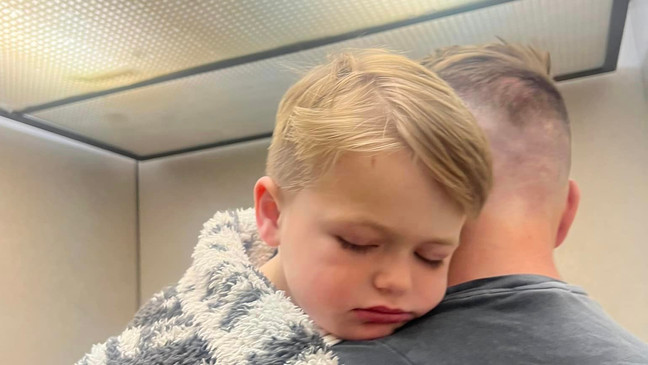
Copperhead bites Tennessee preschooler during camping trip (Photo: Stacey Pollom)
Simms also poked some holes in common myths about treating a snake bite.
You read all the myths you've heard seen in the movies about using a knife and cutting around the wound and "sucking the venom out" and putting a tourniquet on and all of that. That that's not necessary. I mean, just get the medical help. In some cases, people do more damage to themselves trying to treat the snake bite than they would have from the snake bite.
As for Jad, he's smiling again and on the mend, and he and his family will keep a close eye out for snakes the next time they hit the great outdoors.
-
 0
0 -

Yikes, scary time for the parents i'm sure.
0 -

Sorry, but the "Highlands" are where @Butchdog3 and I live. Around Boone, NC, Roan Mtn. Grandfather Mtn. Etc. (Not around/near GA.)
Sorry the kid got bit, glad he is recovering. 👍
0 -

Glad he is OK..I bet that flight was EXPENSIVE!
0 -

So was the antivenom, and that is a whalloping dose for a copperhead bite.
0 -

KIMBERLY CATAUDELLA
Updated May 28, 2023 at 11:49 AM
Snake bite season has begun, and local emergency department doctors have already been treating bites for a few weeks.
Dr. Charles Gerardo, emergency medical specialist with Duke Health who specializes in snake bites, has already seen four patients this year. As temperatures climb and we start spending more time outside, the number of snakebites will increase, bringing three to four snakebite patients to hospitals per week.
Copperheads, a venomous pit viper that calls North Carolina home, will do most of that biting here.
Treating these bites can be expensive. But international snake experts who work at Duke Health and WakeMed want to make one message clear: Always seek care.
“Costs aside, purely medically speaking, the risk-to-benefit ratio clearly favors treatment, even for mild bites,” Gerardo said.
“Some people say, ‘Because of the cost, I’m going to wait and see if it progresses.’ There’s good evidence that the vast majority of the time, early treatment is better.”
Only about 25% of patients require antivenom as part of their treatment, said Dr. Ryan Lamb of UNC Health Rex, through a spokesperson.
The Charlotte News & Observer spoke with emergency medical professionals and billing experts at Triangle hospitals to understand how much snakebite treatment, including expensive antivenom, costs this year. Here’s what we learned.
How much does snake antivenom cost?
The N&O spoke with UNC Health, Duke Health and WakeMed to learn the market price of antivenom:
• At Duke Heath: The N&O reported in 2020 that a 12 vials of antivenom — double the typical initial dose, — cost $200,000.
0 -

$200.000 for antivenin? Wooo, that just doesn’t seem real. However I would imagine there is a pretty small market in venom collecting. I would imagine insurance would cover it. I’m glad he is going to be alright.
0 -

Glad the little guy is Ok. It's real easy for a young child out playing to step on or get close to a snake and get bitten
3 -

A friend's granddaughter, 7 y.o., got bit by a copperhead a couple of years ago. The snake was killed and brought to the hospital with the girl. She went home the next day, an almost venom free bite.
0 -

A Copperhead's camouflage is so good that they don't even attempt to flee when someone comes near them and they are an aggressive snake.
When we had our property in Tennessee, our nearest neighbor had a small garden that he was showing me and there in the plants was a Copperhead, I swear, if it wasn't for seeing his eyes, he was completely invisible even when looking directly at him from three feet away.
The two worst things about that property was the Copperheads and the ticks, running in third place was Scorpions, every time you turned over a rock there was at least one and sometimes two or three of them under there.
Copperheads are related to water moccasins and are equally aggressive, bites cause the flesh to rot.
0 -

bullshot: 30292123878811/comments/
A Copperhead's camouflage is so good that they don't even attempt to flee when someone comes near them and they are an aggressive snake.
When we had our property in Tennessee, our nearest neighbor had a small garden that he was showing me and there in the plants was a Copperhead, I swear, if it wasn't for seeing his eyes, he was completely invisible even when looking directly at him from three feet away.
The two worst things about that property was the Copperheads and the ticks, running in third place was Scorpions, every time you turned over a rock there was at least one and sometimes two or three of them under there.
Copperheads are related to water moccasins and are equally aggressive, bites cause the flesh to rot.
This may be TMI, but... The young son of the Superintendent at one of the parks I worked in the 70"s was bitten in the same place by a copperhead. I was shocked to find out that after the antivenom treatment, they treated the bite with maggots to clear the dead tissue. Don't know if they still do that...
0 -
When last I imported antivenom (2009), I paid $1100 per vial (I used a very good Mexician antivenom for pit vipers like the rattlesnakes and copperheads, because there is no longer an antivenom produced in the US). Hospitals here were charging more than 5 times that per vial. It has not likely gotten cheaper. At that time, some of the Australian antivenoms were over $6000 per vial (Taipan for one). My budget for antivenom greatly impacted the species I could keep and could not afford to keep. I refused to keep anything I could not stock antivenom for. My staff was much more valuable than a snake or two. During my 31 years there there was one venomous bite, and we had antivenom on hand to treat it.
6 -

Very scary. Glad he made it.
0 -
Long ago there was a big story in Sports Afield magazine, they were down in South America, where there are lots of poisonous snakes. They were treating snakebite with dc shock. Hook up 2 wires to the spark plug wire and engine of an outboard motor, hold the other end of the wires onto the bite and pull that cord 3 or 4 times.
They said they had cured a dozen snakebites with dc shock. I told Hedog about it, on this forum, and he said the shock treatment was a pile of doo doo.
0 -

Copper heads have never been seen here at my place, nor rattlers.
They have been seen and disposed no more that 2 miles away but then the elevation drops from 3500 feet to 2000 rather quickly.
Two years ago my neighbor, less than a half mile away, brought a picture for me to look at.
Young copperheads,around 12 inches long, and the last few inches of the tail were yellow. They did not know what they were.
They were found in the living room toy pile and one was crawling towards a toddler. Parents seem to think the were brought in with a firewood delivery. Who knows?
Talk about a house evacuation and all point search and destroy mission.
0 -
@Butchdog3, Copperheads and Rattlesnakes are in abundance in my Holler.
The Rattlesnakes are a very weird green color. Much better camouflage for them. Very strange color.
0 -
Me no likey the snakes!
0 -
allen griggs: 30292123878811/comments/
Long ago there was a big story in Sports Afield magazine, they were down in South America, where there are lots of poisonous snakes. They were treating snakebite with dc shock. Hook up 2 wires to the spark plug wire and engine of an outboard motor, hold the other end of the wires onto the bite and pull that cord 3 or 4 times.
They said they had cured a dozen snakebites with dc shock. I told Hedog about it, on this forum, and he said the shock treatment was a pile of doo doo.
To say the very least, life threatening Voodoo.
Ken, where is that Holler? Fewer species in the east, than here in the west, but timber rattlers are not known for great variation in coloration.
3 -

My niece was barely two years old when she was bitten by a very large Copperhead, just under 3 feet long. Only one fang connected. Either the snake was missing one, or the child's leg was so skinny one fang missed.
I don't remember all the details, but she did swell up a good bit, and even now, 50 years later, she still has a scar on her leg.
0 -
@...: 30292123878811/comments/
Me no likey the snakes!
Me either.
0 -

Glad he is OK
Scary stuff for all
wow the cost to his family or insurance if they have any is just crazy
0 -

@...: 30292123878811/comments/
Sorry, but the "Highlands" are where @Butchdog3 and I live. Around Boone, NC, Roan Mtn. Grandfather Mtn. Etc. (Not around/near GA.)
Sorry the kid got bit, glad he is recovering. 👍
There is also a town called Highlands, NC. that is where I live.
 6
6 -
David Nunn: 30292123878811/comments/
My niece was barely two years old when she was bitten by a very large Copperhead, just under 3 feet long. Only one fang connected. Either the snake was missing one, or the child's leg was so skinny one fang missed.
I don't remember all the details, but she did swell up a good bit, and even now, 50 years later, she still has a scar on her leg.
Every aspect of a bite is controlled by the snake. They can bite without ever erecting either fang, only one, and they can choose to envenomate or not. It has been written that in Colombia where there are many snake bites, 80% are dry bites: no envenomation. That is much less true in India where bites are mainly from cobras.
0 -
Interesting to know @clays. I was unaware there was a town/city named "Highlands."
Our entire area, is known as the Highlands. Similar to the Scottish Highlands. There are more Scottish people/Ancestors here than anywhere else outside of Scotland. The Highland Games are held here of Grandfather Mountain. The largest gathering of the Clans outside Scotland.
Beautiful area.
@He Dog, I will PM you the specific location. (And) See if any buddies have photo's, of the Green Rattlers here. I am about 5-7 mi. from the infamous Copperhead Rd. (Quite a few relatives that live there.) I used to put up hay and cut/hang tobacco there, growing up.
0 -
Highlands is where the rich build second and third homes homes.
Nice area but not much different than around here.
0 -

I was bit by a copperhead in my left arm while putting up hay I was about 11 my left forearm looked like Popeyes I still carry the scars on that arm
0 -

We were putting up hay bales in a barn near Swannanoa NC.I moved a bale and there were a pile of of young copperheads under it.I eased the bale back down over the snakes while the guy I was helping went to the truck and brought back a single barrel 16 gauge.I used a hoe to push the bail over and he shot and hit about a foot in front of the ball of snakes,which propelled them up about 6 feet in the air and it was raining very upset copperheads.Nobody went near that barn until dead of winter and the temperature dropped below 20 degrees.
0 -

Yep, copperheads always seem to be in bunches, so if you see one, you’d better take a close look around you for others.
I remember years ago my brother and I were fishing the Peddlar River in VA. Camped at Panther Falls and went for a swim in the hole beneath the water fall. I went to climb up the rocks and there was a large copperhead in the rock shelf staring at me 6 inches from my face. Eased back, but then there was another by my right hand……and one by my left foot. Finally just decided the best course of action was to lean back and just fall into the pool. Got out and we looked around. Must have been a dozen of those suckers tucked all around that pool. Very fortunate to not have stepped on or grabbed one as I moved around. Luckily, it was pretty cool outside, which I think saved my bacon, since they were a little slower to defend themselves against the dummy climbing through their sunning spot.
0 -
Some facts are needed here. Snakes, all snakes, including copperheads are predators. That makes them competitors for food, thus they tend to space themselves in the habitat. Usually females occupy a small territory, and males occupy a territory which is larger, overlapping that of some females and usually other males. Thus, they are not in groups or bunches. They emerge from dens that are usually communal in the spring and spread out over the territory occupied by snakes from that den. During the years usually in late spring, mating occurs and there may be two or three males courting a female, and in combat with each other. This is a time when they may be encountered in small groups. Later in the year, females give birth to a brood of young. For a time the young may be found in close proximity. By autumn the young have dispersed and there are no groups. later in the autumn, the snakes in that area move to the dens and are again seen in fairly close proximity or even in close proximity. Historically the dens were in the ground, most often in rock structure with layers, cracks and cavities that allow them to get below the frost line, where they spend the winter. In most cases, they are not dormant, but are somewhat active and reactive in the dens. We have seen snakes in dens at below 32 which are active and defensive, offering to bite. In spring, they leave the dens, usually during warmer days and bask in the sun near by. They are then again in close proximity. When the temperature has risen enough, they leave the den for the year and disperse again. Since the invasion into their habitat of an vermin, known as humans the rules have changed. Humans build houses and cellars and root or storm cellars which work pretty nicely as hibernation (actually they brumate, not hibernate, but every one knows hibernate) dens, causing human encounters. While people tend to see snakes as the problem, they see it in quite the reverse. My experience has been if they are not messed with, they are not a problem. But don't build your house over or very near a den. I have never found a need to kill a snake, there are other ways of dealing with them, but your milage may vary.
3 -
I wonder why the little mite needed 10 vials of antivenom. Obviously his parents got him to the ER pretty quickly. Even if you are on vacation far from home, you just punch in "hospital" on the Iphone and the Iphone will not only list the closest hospital, but take you right to the ER door on the GPS. As others have stated, the rattler, and the cottonmouth venom are more toxic than copperhead.
It seems like two or three shots would have fixed the little kid up.
And then, after those 10 doses, they had to transfer him to the big hospital in Chattanooga. It doesn't say if he was given more antivenom at the big hospital.
0
Please sign in to leave a comment.
Comments
31 comments