Locust Tree Thorns

A year or so ago I asked if they would disintegrate when cut and was wished good luck! What about burning them or am I just wasting my time?
-

They will burn
0 -

They will burn if not petrified. The thorns seem to get hard as a rock and the ones in the burn pile next to the ground may not burn completely. I would remember where the burn pile was located and avoid that area with rubber tired equipment.
I had one run through a shoe sole and into the ball of my foot few years ago. I had to crow hop to a tool box and I had to use a pair of pliers and pull the thorn before I could remove my shoe. Was lucky it did not break off in the shoe or foot.
They will also ruin rubber tires fast (causing slow leaks) even the little ones on the small locust sprouts.
I now have a respect for those thorns. (but hate them)
6 -

Okie is correct. The previous owner of the farm on which I live let 'honey locust' trees get a foothold. I've fought them for 43 years and not gaining on the infestation. Even when pulled out with an excavator, any root within several inches of the soil surface will grow into another tree. We had some 2' diameter honey locust torn out by the roots 90 days back and there are new trees growing in a 50' diameter around the original tree's location.
I have a set of 'logger tires' for the tractor used on the brush hog. These are 10-12 ply tires (old and stiff) and will resist puncture by anything less than a nail gun. The brush hog sits on 14-20 ply airplane tires. That's the only way to operate machinery around locust thorns.
3 -

I have run 3 or 4 of them through my hand while clearing brush. Unforgettable.
0 -

My farm is loaded with them.
I figure that I just have to learn to live with them.
Any tree I cut down, if I don't spray the stump, I will have a locust bush which is less desirable than a tree.
3 -

What do you use to kill the stumps?
0 -
Gordons Stump killer, I get it at Rural King.
6 -

Chief Shaway: 29997339396891/comments/29997352319643
Gordons Stump killer, I get it at Rural King.
I was gonna ask if you guys couldn't pour crossbow or some kind of weed/brush killer full strength on fresh cut stumps. That's what we do around here when the alder trees get out of hand.
3 -

We thankfully don't have locust trees, but another extremely invasive species, Autumn Olive. They have completely taken over our property.
I have tried pulling them out, and as stated by Mobuck, the root system continues to produce. I've used 2/4-D for several years on the leaves with moderate success. I guess I will try the stump killer unless someone has a different suggestion.
0 -

If you can mow the area weekly for year or so, then you can drop back to every month or so, I have had luck doing this with quince apple bushes, had to mow an extra 6-8 foot swipe that first year after cutting the main "bush" out since then the once a month has kept them under control.........
0 -

For me, it is invasive Wild Grape vines. I has really taken over the woods beside my house. (Huge Vines.) [Everywhere.] Now, it is sending wrist thick underground shoots to come up and run rampant among my plantings, on my Property.
Cut them off, they send up about 15 shoots, to go up the same trees.
Aarrgghh..................................
Communicating to my next door neighbor, on what she is using to kill the Invasive Bamboo, on our shared property.
0 -

I have good luck using Tordon by just painting the stump. I also use it on small brush that comes up in the yard, just nip them off and paint. Many years ago they had 2-4-5/T that was a great brush killer when used right. You could just paint it around the trunk and it would kill any tree. Unfortunately, the government used it indiscriminately as agent orange.
3 -
My next door neighbor had a infestation of Bamboo. Notoriously hard to kill. If I recall correcty, she was using Tordon. (She just confirmed it.)
(As above.) That appears to be the answer.
0 -

Napalm. 😉
0 -

I've managed to get rid of all the locusts trees except for one big one next to the driveway gate by the road. Cut down an burned them and used stump killer. Last year during a storm a pine fell near the one by the road and needed to be cut up and moved. I've kept the locust trimmed up so as not to run into the thorns while mowing but hadn't noticed a branch pulled down by the fallen pine. Dang thing almost gave me a pierced ear when I backed into it dragging out the cut up pine. Whoo - doggies that smarts!
The hardest trees I have a problem getting rid of are Mulberry. Nothing seems to work 100% on those. Bob
0 -
On the other hand. Locust is great firewood. I just split up a truckload of locust two days ago. 28 Million BTU per cord, there is nothing better. The big 15 inch locust like this one don't have thorns. But, the little 2 inch locust, look out!
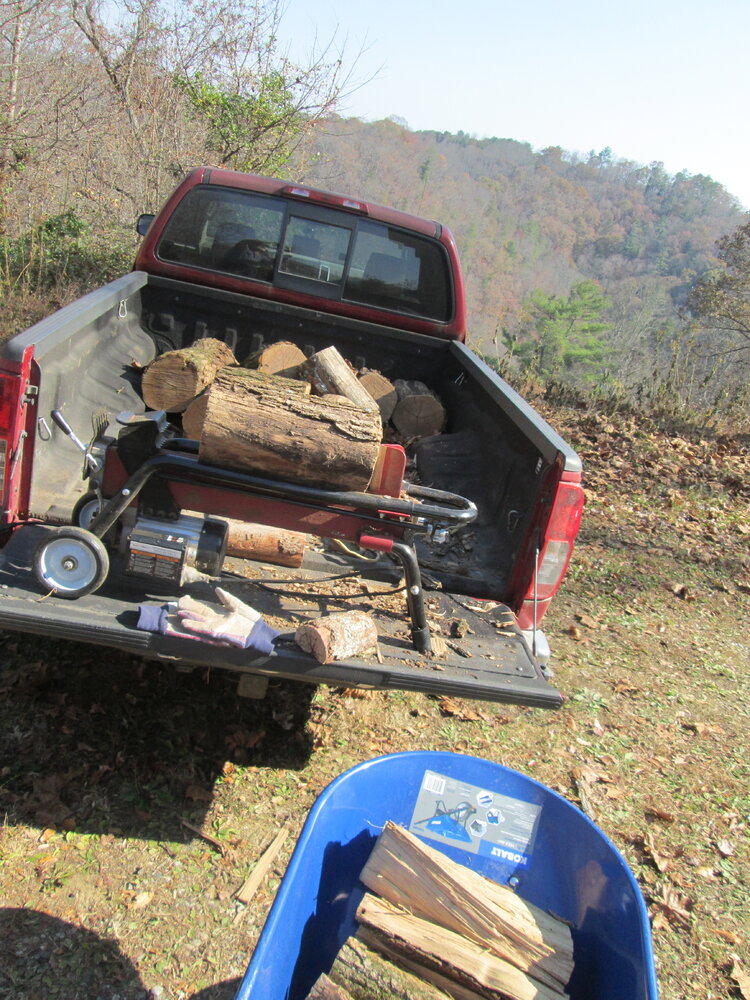 3
3 -

Locust fence posts are VERY good quality fence posts. The Amish will buy all you can cut and split at good prices if you will truck the posts to them.
Ask me how I know?!? I should add this was 35/40 years ago.
There are two kinds of locust, that that splits and that that don't. If you have a locust grove on top of a hill and the trees become "wind shook" the grain isn't straight and splits very, very hard.
If your locust grove is lower down where the wind doesn't get to it, the locust splits really easy.
0 -

Tordon will translocate to nearby roots. Don
9 -

As above,,and I know how hard they can be. Downright almost impossible to deal with.
Autumn olive, catch them early. Hired a big Caterpillar to doze mine.
0 -
The type locust that makes good fence posts if cut when the sap is down in fall of year is Black Locust and has smaller thorns. I've seen them so hard when they cured that a fence steeple could not be driven into them nor pulled out if driven in before they dried.
The Honey locust is type that makes the long big bean pods and has the bigger longer thorns and the tree usually gets larger than the honey locust and the long thorns on a mature tree will also be on the tree's trunk. The large thorns can also branch off of themselves producing multiple thorns. I've heard rumors that Deer like to eat the Honey Locust bean pods in fall winter, but I've never seen them do so.
Both types when the tree or sprouts are cut will produce numerous sprouts from their roots. A good strong non-selective herbicide will eventually kill the roots if sprayed on the small sprouts and stumps if used on a yearly basis. May take 5 years or longer. But may kill desirable trees as well if in close proximity.
You can review Honey locust vs Black Locust on-line.
0 -
"I was gonna ask if you guys couldn't pour crossbow or some kind of weed/brush killer full strength on fresh cut stumps."
We use Crossbow mixed 25/75% with diesel fuel and a 'colorant' so we know which stump has been treated.
Okie743's post is on target and correct. Some folks confuse post(black) locust with honey (thorny) locust. The 'female' (the ones with fewer thorns that produce the seed pods) honey locust make excellent firewood and are quite weather resistant above ground. Over 40 years ago, I had a local sawmill cut fence lumber from the pod producing honey locust logs and those boards exposed for 4 decades are still solid.
Both types of locust will grow from roots close to the soil surface and therefore are EXTREMELY difficult to control.
0 -

This is the stuff to use:
0 -
My next door neighbor had a infestation of Bamboo. Notoriously hard to kill. If She was advised and has been using the above mentiond Tordon on the stumps, once cut.
I'm going to get some in the Spring, to use on a bunch of Wild Grape vines, that think they are going to take over my property. Cut one, it branches out, comes back as 5-10.
Aarrgghh..........................................
0 -
Yes, the trees around here are black locust. On a small, 2 inch diameter tree the thorns will be about 1/2 inch long. I don't even want to know about honey locust.
0 -
One must be careful using TORDON as it will translocate through roots and kill non-target plants quite some distance away from the application site. Another issue is it's residual carryover. It can and will damage susceptible vegetation for several years.
3 -
Mobuck: 29997339396891/comments/29997380613275
One must be careful using TORDON as it will translocate through roots and kill non-target plants quite some distance away from the application site. Another issue is it's residual carryover. It can and will damage susceptible vegetation for several years.
Very true: Just try planting some fruit trees few years later in vicinity.
Especially if the sub soil has some clay, the herbicide just seems to hangs out and wait for you plant something for it to kill. Sometimes a new planted tree may even live couple years then all at once get herbicide cancer.
3
Please sign in to leave a comment.
Comments
26 comments